
Power your houseboat without carbon footprint
Driving houseboats powered by an electric engine is becoming more and more popular. At this time, most of them have to be recharged at a plug-in station; however, with innovative systems such as the PowerRouter and soon Tesla’s Home Battery, this is something (almost) of the past.
The innovative battery of electric car brand Tesla will not be available until this summer, but the concept is crystal clear. The basic idea of these systems is that you load batteries during the day with solar panels, or when the rates are low such as at night, and you use the stored energy whenever you need it. The highly improved quality of these batteries has led to a decrease in size and still delivers more power than ever.
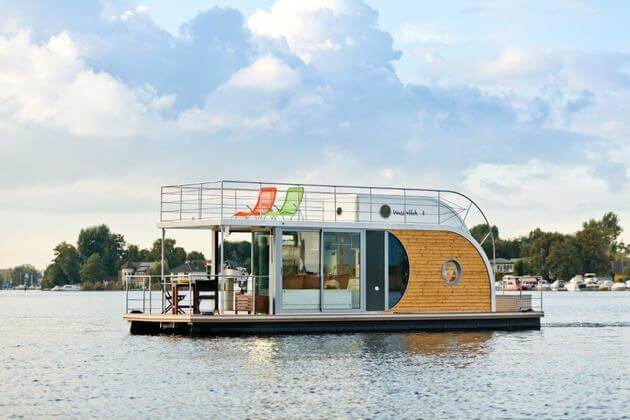
Houseboats and solar power
Not all houseboats will be suitable for solar energy. If your boat is moored in a spot with hardly any sun, the energy production will not be enough to justify the investment. However, for floating homes that are located in a sunny spot, or boats that are usually being driven around, a modern battery system is just perfect. The only disadvantage that we could find so far is that you might have to give up your roof terrace to place your solar panels. But first, let’s have a closer look at the current market leader: PowerRouter by Nedap (discontinued in 2016).
Efficiency improvement
The PowerRouter combines a new generation of inverters with an innovative battery manager in one single unit. This results in a set that optimizes the energy consumption that is generated by the solar panels on the roof. And optimizing is what it’s all about: the more efficient you use your energy, the less you need, and the longer a battery will keep all your devices running. All the energy that is not immediately used by the electric devices in your houseboat is stored in the batteries to be used later.
Increase your self-consumption
In general, only 20 percent of all the energy generated by solar power can be used right away (self-consumption), so it’s useful if you can store the remaining energy. This way, you can increase your self-consumption up to 70 percent. This is especially interesting if you’re not connected to the grid (i.e., when you’re driving your houseboat) or when the rates that are paid for energy given back to the grid are lower than the energy price. Of course, when you are driving your houseboat, the engines will need more energy so the battery will charge less or drain – depending on the amount of sun. But if the batteries were charged with the solar panels, you’re still driving around for free!
For more information, check https://www.powerrouter.com/en/ (discontinued in 2016) and https://www.tesla.com/powerwall